One AI companion, many posts: a fleet of specialist agents on an
always-on Mac, reachable by voice in your ear and WhatsApp in your pocket —
running the real-life admin of a family of five.
Built and operated by Nicholas Jenkins.
Currently a closed, personal project. Ambitions to launch to public soon.
What I built, and what the platform provides
The platform — Anthropic's Claude Code
Agent sessions and the models behind them
The permission system that gates risky actions
The channel seam that plugins publish into
Session persistence on the always-on Mac
What I built on it
A native iOS voice-capture app and its Mac sync server
Doorman/desk routing — file-mail between agent sessions
A ~250-line WhatsApp transport adapter (official Cloud API)
A governed skills marketplace with a security gate
Policy “operating models” that live in Apple Notes
Telemetry wrappers around every credentialed operation
The harness is deliberately not specific to Claude Code: identity, policy, and
skills live outside the host — proven by a host migration, below. Looking for my
data science work? That lives across the wider portfolio at
ndjenkins.com.
What Melue actually does
Ran the life admin of an international move
An agent fleet helped orchestrate a family relocation across hemispheres —
and a first-home purchase along the way: research, paperwork sequencing,
briefs for the professionals, and the thousand small decisions in between.
Hands-free voice, anywhere
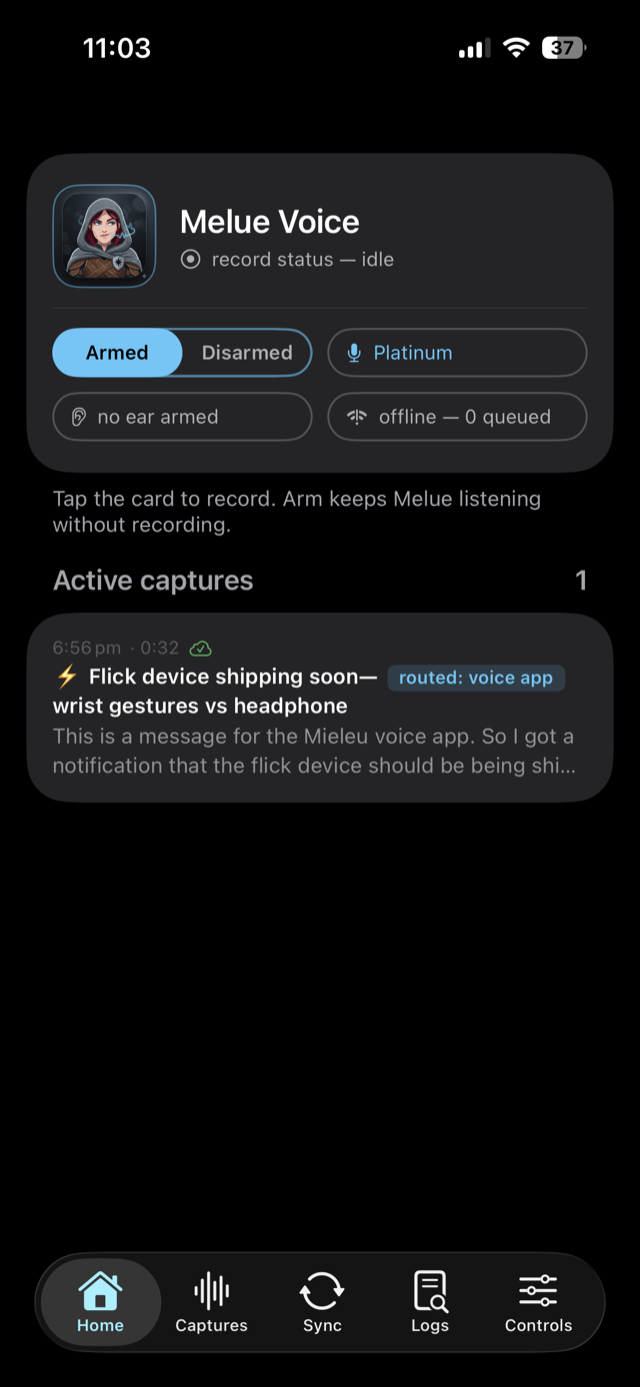
Speak into your headphones on a walk. Within seconds a live agent at home
hears it, acknowledges out loud, and answers, files it, or routes it by spoken
address to the right specialist — which replies in its own voice.
A WhatsApp line of its own
Melue speaks WhatsApp as a business on Meta's official rails — invite-only
by construction: unknown numbers are dropped before any AI ever sees them.
Hands full, ears free. The whole system exists because of moments like this one.
The voice loop, measured
32–55 mspress → recording
4.7 scapture → transcript
2.7 sbest wake → spoken ack
0voice notes ever lost
Honest numbers, not just the highlight reel: acknowledgements run ten to twenty
seconds in daily use (p50 9.5 s, p95 19.2 s), and a routed question's full answer
arrives minutes later — spoken into your ears. Notes queue through train tunnels
and airplane mode and deliver on reconnect.
One always-on doorman session holds the ear. Eight specialist
desks — each warmed into one corner of life or code — receive work as
mail: plain files on disk, atomic renames as the state machine. (We reinvented
qmail's Maildir and only noticed afterwards.) On the last audited day, 17 of 17
captures ended in a known state with zero drops, each with its own audible receipt.
The first morning, acknowledgements took 74 seconds to 4.5 minutes; a same-day
rewrite collapsed the whole wake path into one shell call and brought it under ten.
The war stories are the design story. iOS forbids starting the microphone from
the background — full stop — so the honest architecture fell out of the
constraint: armed-mode capture, a lock-screen control, wrist-button triggers.
Classic Bluetooth was eliminated the hard way (its call-audio mode kills the same
device's buttons); the breakthrough was a side door — volume-key events aren't
gated, so the trigger is the volume channel. When the cloud text-to-speech
quota died mid-dogfood at 9,991 of 10,000 calls, the phone learned to speak replies
itself the same evening — acknowledgements now cost nothing, forever. And a $9
Bluetooth clicker worked on the first press, zero code changes.
The app is deliberately thin — capture, sync, speak. The intelligence is the fleet behind it. (Staged content.)
The harness, not the host
Melue isn't an app, and isn't a wrapper around one chatbot. It's a harness: a
fleet of agent sessions, a private marketplace of governed skills, shell wrappers
with telemetry, and policy documents — “operating models” — that live in Apple
Notes, editable from a phone on a train and picked up at the next agent boot.
No deploy.
Voice — headphones, watch, clicker · WhatsApp — official Cloud API
↓
Doorman one always-on session, holding the ear
↓
File mail plain files on disk, atomic renames as the state machine
↓
Eight specialist desks warm agent sessions, each answering in its own voice
Policy: operating models in Apple Notes · Skills: governed marketplace · Credentials: walled vault
The proof it's a harness: it survived a host migration. When the v1 runtime
became economically unsustainable, identity, policy, and skills simply moved —
none of them lived inside the host. The policy note that governed v1's WhatsApp
line became v2's access design without a rewrite. Policy outlives hosts.
The WhatsApp channel shows the seam working. v1 spoke WhatsApp by pretending to
be a web browser — and died the way unofficial clients now die. v2 speaks it as a
business: official Cloud API, signature-checked webhooks, an allowlist wall, and
roughly 250 lines of adapter into the harness's channel seam — written before any
Meta credential existed, from the contract alone. Investigation to answered
message in one session. Channel mechanics.
Governed and secure by construction
The interesting problem isn't making an agent capable; it's giving a capable
agent real access, safely.
The banking and personal credential vaults are physically out of reach —
enforced at the credential service's account layer, not by the agent's judgment.
Email access was granted only after a 19,272-message study produced a
least-privilege allowlist.
Skills ship through a review gate that fails closed — no security pass,
no publish.
Logs are metadata-only; message bodies never touch them.
When the WhatsApp build needed a tunnel to the internet, the harness's own
permission gate refused the agent and required a human hand. The security model,
demonstrating itself.
The instinct is inherited: v1 ran inside a firewalled virtual machine with a
block-all network policy and a disposable golden image. v2 keeps the posture.
The story: three contracts
Melue is played as a character — Melue of House Dallas, leatherworker by birth,
rogue by training. It began as a way to make a tool pleasant to talk to; it turned
out to be load-bearing. Her “contract history” is the project's real migration
timeline:
Clawdbot — first post: an agent running directly on the host machine.
OpenClaw — second post: rebuilt inside a firewalled VM after a security rethink.
Claude Code — the current post: the session fleet and skills marketplace above.
Houses come and go; tenets persist.
The tenets are the engineering, stated in-world: memory is sacred
(durable surfaces over chat scrollback), context is consciousness (warm
sessions over cold starts), serve without subservience (an agent that
pushes back).
What's next
A wearable button with three mappable gestures is days away. A paid developer
account unlocks iOS Push-to-Talk. WhatsApp messages landing in live agent
sessions — and approving the agent's permission prompts from WhatsApp itself. A
family group thread with Melue as a participant, when Meta's Groups eligibility
lands. Fleet supervision: who watches the watchers. And the long-arc thesis: the
trigger shrinks to a ring.